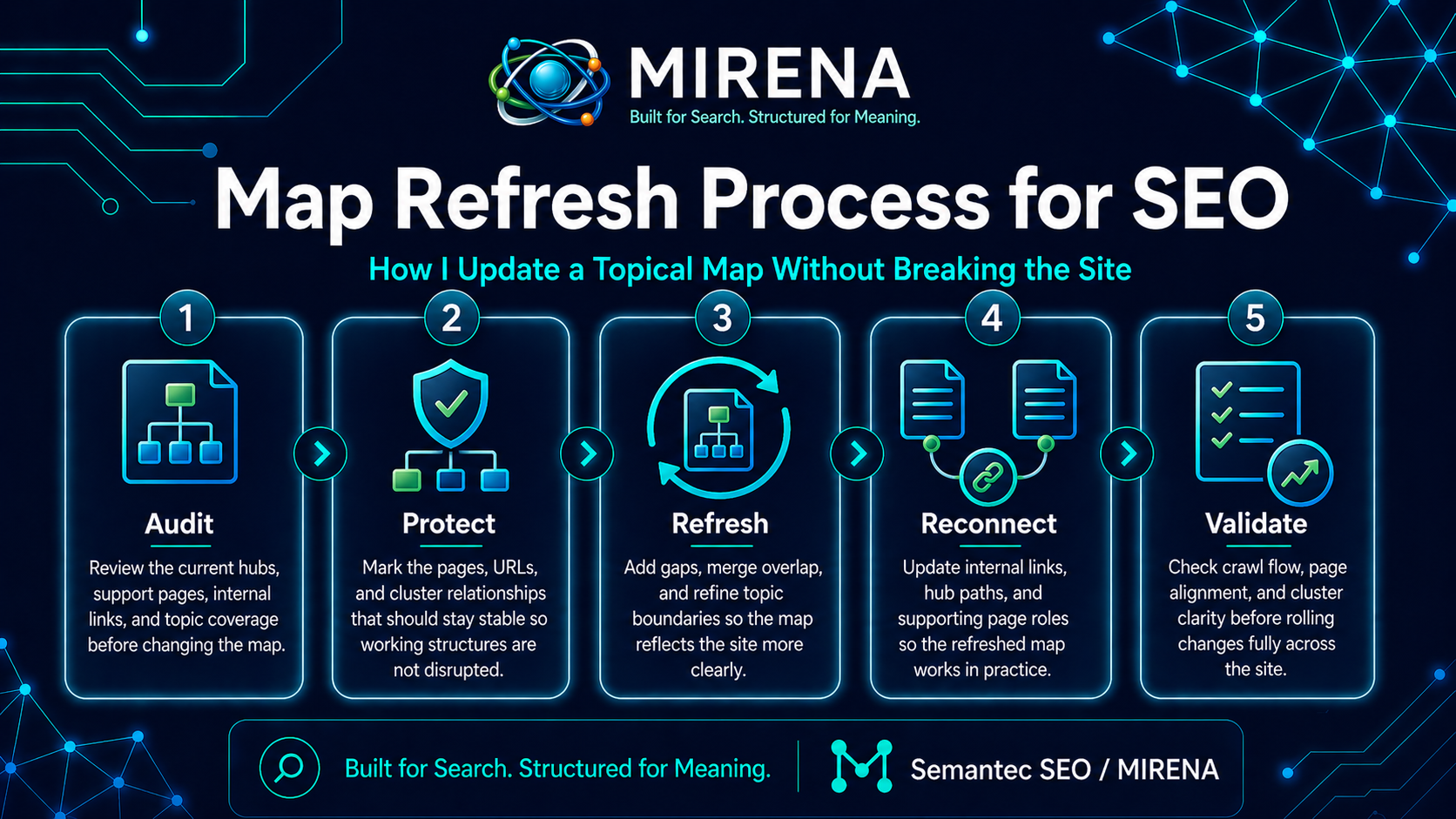
A topical map should not stay frozen.
As a site grows, clusters drift, page roles blur, and old publishing decisions stop fitting the shape of the site. That is where map refresh work comes in. I use a map refresh process to review the structure, check what changed, and decide what needs to be merged, split, moved, or upgraded.
On Semantec SEO, this page sits in the Topical Mapping cluster beside Topical Map Process, Topical Map Audit, Publishing Order, Topic Consolidation, and Topic Splitting.
The short answer
A map refresh process is the work of updating a topical map after the site has changed.
I use it to answer questions like these:
- which clusters still make sense
- which pages now overlap
- which hubs are too broad
- which spokes are too thin
- which topics need to be merged
- which topics now deserve their own page
- which pages no longer fit the cluster they sit in
A map refresh is not a content cleanup only. It is a structure review.
Why a topical map needs refresh work
The first version of a topical map is a planning model.
The next version has to deal with live pages, old decisions, internal links, new topics, and shifts in site direction. A cluster that looked clean at launch can get messy after months of publishing. New pages get added too close to old pages. Hubs pick up child topics that should live elsewhere. Spokes drift into mixed intent. Some pages sit live with no clear role at all.
That is why I treat map refresh work as a routine part of site growth, not as a one time fix.
When I refresh a topical map
I refresh a map when one or more of these signals show up:
- the cluster has too many overlapping pages
- the hub pages feel broad and loose
- new content no longer fits the original model
- internal links feel random
- old pages do not have a clean place in the site
- multiple pages target the same need
- the publishing order has changed the balance of the cluster
- support content has grown faster than the commercial spine
If I can feel the structure getting harder to explain, I know the map needs a refresh.
What a map refresh is trying to fix
A refresh process should improve structure, not just create a prettier spreadsheet.
I use it to fix five core problems.
1. Overlap
Two or more pages target the same topic or the same user need.
2. Drift
A page sits inside a cluster but no longer fits the parent topic.
3. Weak page roles
The page exists, but I cannot say if it is a hub, a spoke, a comparison page, a support page, or a section level topic that never needed its own URL.
4. Poor cluster balance
The hub is thin, the child pages are heavy, or the support content has expanded with no clear parent structure.
5. Broken routing
The page paths, internal links, and next steps do not line up with the topic model anymore.
My map refresh process
This is the process I use when I want to refresh a topical map without creating new confusion.
1. Pull the live page inventory
I start with the site as it exists now, not the old ideal map.
That means I want a clean list of:
- live URLs
- page titles
- current hub and cluster placement
- page type
- primary topic
- notes on overlap or drift
If I skip this step, I end up refreshing a model instead of refreshing the site.
2. Recheck page roles
Next, I review each page role.
I ask:
- is this page a hub
- is it a spoke
- is it a use case page
- is it a compare page
- is it a support page
- should this only be a section on another page
This is where Page Role Assignment becomes useful. A refresh gets easier when every page has one clear job.
3. Audit overlap
Then I look for pages that compete with each other.
This can happen in a few ways:
- same topic, different wording
- same intent, different framing
- same cluster, weak separation
- one page that should have absorbed the other long ago
If I find overlap, I move straight to a decision. Keep both with sharper separation. Merge them. Or fold one into another as a section.
That is why Cannibalization Prevention and Topic Consolidation sit so close to this page.
4. Check hub strength
A weak hub creates weak child paths.
I look at each parent page and ask:
- does it define the cluster fast
- does it show the main child routes clearly
- does it still fit the broad topic
- does it link to the right children
- has it picked up detail that belongs on spokes
If the hub feels crowded or vague, I rework it before I touch the children. Hub Page Design is the right follow up page for that review.
5. Review spoke fit
Once the hub is stable, I look at the child pages.
I want to know:
- does each child solve one narrow need
- does it still belong under this parent
- has it grown into a new branch
- does it deserve a new sibling path
- should it move clusters
This is where Spoke Page Design and Query Deserves Granularity become useful. Some child pages need a sharper frame. Some need a different home. Some never needed their own page.
6. Check the cluster boundaries
A lot of map refresh work comes down to boundaries.
I review where one cluster ends and another begins. If the lines are weak, the site starts to feel mushy. Pages float between hubs. Child topics leak across the site. Internal links start pulling readers into side paths too early.
This is why Cluster Boundaries and Parent Child Topics are useful companion pages.
7. Reorder the publishing model
A refresh should not only fix the old map. It should improve the next publishing cycle.
I review:
- which hubs need attention first
- which missing pages now block the cluster
- which low value pages can wait
- which topics are ready to move into briefing
That is where Publishing Order comes in. A refreshed map should feed the next build cycle, not just describe the last one.
8. Update internal link routes
Once the structure is clean, I update the link plan.
A refreshed map should make it easier to answer:
- which pages link back to the hub
- which siblings link across
- which pages should route into the next workflow lane
- which old links now point to the wrong place
For that part, I move into Semantic Internal Linking and Internal Link Briefing.
9. Push the refreshed map into briefs
The map refresh is not done until it changes production.
That means the refreshed structure should flow into Intent Led Brief, Entity Led Brief, and the right use case path inside MIRENA for Topical Mapping.
A clean map with weak handoff still leaves the team with the same old content problems.
What I look for during a refresh
When I review a live cluster, these are the questions I keep asking:
Is the parent topic still clear
If I cannot explain the cluster in one line, I know I need to tighten it.
Does each page have one job
If the page feels like a hybrid, I flag it.
Are the child pages distinct
If not, I am looking at overlap.
Does the hub still hold the cluster together
If not, I fix the hub first.
Do the links follow the topic structure
If not, the site will keep reinforcing the wrong paths.
Common refresh mistakes
Refreshing the map without reviewing live URLs
That leaves the structure disconnected from the site.
Moving pages without rechecking page roles
A moved page with a fuzzy role stays fuzzy.
Keeping weak pages for the sake of volume
More pages does not mean a stronger map.
Merging too fast
Some overlap needs separation, not consolidation. I want the decision to come from intent and role, not from panic.
Fixing links before fixing structure
If the cluster model is wrong, the new links just reinforce the wrong model.
A simple before and after test
Before the refresh, I ask:
- is this cluster hard to explain
- do the pages overlap
- do the child paths feel muddy
- does the hub feel weak
After the refresh, I want the opposite:
- the cluster has a clear parent
- the child pages have distinct roles
- the boundaries are easier to defend
- the next publishing steps are easier to see
- the internal links make more sense
If I cannot feel that change, the refresh was too light.
How map refresh work helps the rest of the workflow
A strong map refresh improves more than the map.
It improves briefs because the page roles get sharper.
It improves rewrites because weak pages become easier to diagnose.
It improves internal linking because the routes get cleaner.
It improves expansion because new pages now have a clearer home.
That is why I treat map refresh work as a bridge page between architecture, briefing, and content operations.
Final take
A map refresh process is the work of updating the site structure after real publishing has changed the shape of the map.
I use it to clean overlap, reset page roles, tighten hubs, fix child paths, and improve the next round of content decisions. A topical map is not something I build once and then leave alone. It gets stronger when I revisit it, test the structure against the live site, and make hard decisions about what stays, what moves, what merges, and what grows.
If you want to review the structure first, go next to Topical Map Audit, Topic Consolidation, and Topic Splitting. If you want to turn the refreshed map into production, move into MIRENA for Topical Mapping and then MIRENA for Content Briefs.
FAQ
What is a map refresh process in SEO?
It is the process of reviewing and updating a topical map after the live site has changed. The goal is to improve cluster structure, page roles, and routing.
When should I refresh a topical map?
I refresh a map when clusters start overlapping, hubs lose focus, or new publishing decisions no longer fit the old structure.
Is a map refresh the same as a content audit?
No. A content audit reviews pages. A map refresh reviews the structure those pages sit inside.
What should I read after this page?
Go next to Topical Map Audit, Hub Page Design, and Publishing Order.